Architecture of Knowing
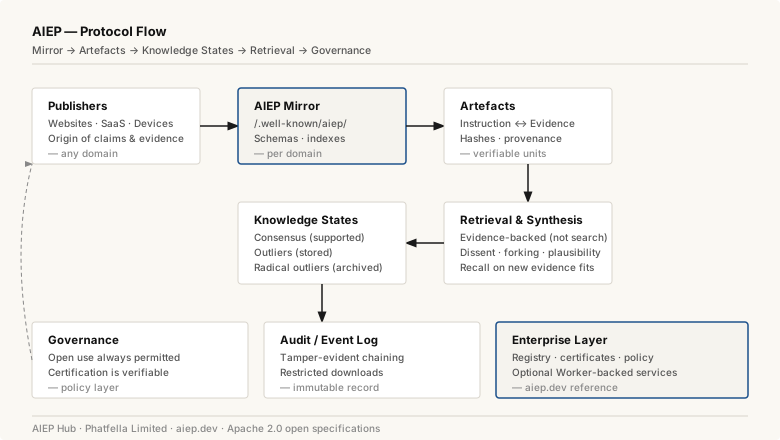
AIEP is not only a file format or a web convention. It is an attempt to respect how knowledge actually grows.
Human knowledge evolves through:
- hypothesis
- criticism
- dissent
- evidence
- revision
The web, however, often collapses these stages into a single outcome: a page that looks authoritative. AIEP separates the stages again by allowing knowledge to exist in multiple states, and by linking instructions to evidence.
The jigsaw metaphor
AIEP can be understood as a jigsaw puzzle with billions of pieces.
Each published artefact is a piece. Each piece carries provenance: who published it, when, and what evidence it rests on.
Consensus is the picture most pieces currently support. That picture is not complete — it is the best configuration possible with the pieces available today.
Outliers are pieces that do not yet fit the current picture. A different shape. A different colour in the wrong place. In most systems, these pieces are discarded — or never published at all.
AIEP does not discard pieces. It stores every piece, records where it came from, and preserves it in a retrievable state. When the surrounding picture changes — when new pieces arrive and alter the configuration — the outlier can be retrieved, re-examined, and fitted in where it could not fit before.
This is how knowledge actually grows. Plate tectonics was an outlier for decades. Heliocentrism was a radical outlier. Germ theory was dismissed. The pieces existed. The surrounding picture had not changed enough to accomodate them yet.
A system that discards outliers cannot recover from that error. A system that preserves them — with provenance intact — can.
The dissent loop
The dissent loop is the core mechanism by which AIEP allows knowledge to evolve without losing history.
The cycle
| Stage | What happens |
|---|---|
| Claim | An artefact is published — an instruction, a finding, a position, linked to its evidence |
| Challenge | Counter-evidence emerges — a contradicting artefact is published by the same or a different issuer |
| Dissent | The original claim is contested — both views are recorded, neither deleted |
| Archive | The minority view is classified as an outlier or radical outlier — stored, not elevated |
| New evidence | Time passes. New evidence appears that was not previously available |
| Recall | The archived outlier is retrieved and re-evaluated against the new evidence |
| Re-evaluation | The outlier may be elevated to consensus — or the former consensus may be demoted |
| New cycle | The re-evaluated position becomes the new claim — and the loop continues |
This loop does not resolve to a final state. It is a continuous process. AIEP does not promise to know the truth. It promises to record the evidence so the question can be asked again later.
Why the loop matters
Without the dissent loop, knowledge systems converge prematurely. The loudest claim wins. The minority view is erased. Future correction becomes expensive or impossible because the evidence chain no longer exists.
With the dissent loop:
- A claim retracted five years later is still traceable — you can see what was claimed, when, and on what evidence
- A position that was wrong is demoted, not deleted — future systems can understand why the correction happened
- Outliers from decades ago can be re-surfaced if new evidence makes them relevant — the pieces were never thrown away
What triggers a recall
Recall is triggered by new evidence arriving that matches the domain of a stored outlier. An AIEP-compliant system can query for outliers in a domain and surface them when new evidence has arrived that warrants re-examination. This is not automatic elevation — it is a prompt to the retrieval agent or human reviewer that a stored piece may now fit.
The mechanical pathway for recall runs through two layers:
- Plausibility registry update — the
PlausibilityScorefor an archived claim-type is updated in the versioned safety registry, via signed assessments from authorised authorities aggregated under threshold signatures. This changes what is eligible to execute. - Deterministic context reconstruction (P22) — when a previously archived branch is recalled, its context is reconstructed exclusively from admissible artefacts in the
ContextRegistry, producing aContextReconstructionHashthat is bit-identical across every node in a distributed system. Recall is not approximate re-assembly — it is cryptographically verifiable reconstruction.
See: Recall for the full mechanism · Plausibility Matrix for the registry-bound gate
Dissent is not misinformation
A common misreading: if an outlier is stored, does that mean AIEP validates misinformation?
No. AIEP classifies, not endorses. An outlier is labelled an outlier — it carries its evidence record, its issuer identity, its date, and its status. A retrieval agent sees the label. The label is not neutral — it is an explicit signal that the current evidence does not support elevation. But the record exists so the question can be asked again.
See also: /misconceptions
How evidence flows
| Stage | Component | Outcome |
|---|---|---|
| Input | New evidence published | Enters the AIEP Mirror surface |
| Discovery | AIEP Mirror (distributed sources) | Evidence collected and indexed |
| Retrieval | Evidence-backed knowledge retrieval | Evidence evaluated against existing records |
| Consensus | Supported evidence | Elevated to consensus — used with confidence |
| Outliers | Contradicting or unresolved evidence | Stored, not discarded — recalled when new evidence fits |
Why this matters for AI
If AI is to become safer and more reliable, it needs a way to retrieve knowledge from sources that publish evidence, provenance, and governance signals. AIEP is a proposal for that layer.
It is not “bigger models”. It is better structure.
An AI trained on a snapshot of the web inherits whatever the web forgot to preserve. An AI that retrieves from AIEP-structured sources inherits the dissent loop — it can ask what the outlier position was, whether it has been re-evaluated, and whether the current consensus is stable or contested.
The future of information retrieval is not search — it is evidence-backed knowledge retrieval.
See also: /architecture · /protocol · /misconceptions · /if-aiep-succeeds